Total Pageviews

Tuesday, 22 July 2014

The Polish switcher TKh2944

 
Here passing Cheddleton on the Churnet Valley
Railway we see rebuilt Polish engine TKh2944
Rebuilt at Cheddleton by the Churnet Valley
 Team. Now in excellent order and the Diesel
was to provide braking during these early
proving runs.
 
 
The history of this class of engine here by courtesy of
 
Motive power shortages after WWII called for rapid production of virtually all kinds of locomotives, from heavy freighters to small switchers. The latter were necessary primarily for major industrial establishments; factories which had their own sidings needed simple and reliable engines designed for hard everyday service rather than for brilliant performance. Demand for heavier switchers was fulfilled by German OS (‘Oberschlesien’), built by Fablok since 1950 as T2D and commonly known as ‘Śląsk’ (Silesia). This 66-tonne locomotive, with the tractive effort of 12.7 tonnes and axle load of 16.5 tonnes, was too heavy and powerful for many operators, so lighter switcher was also needed.
In fact a design for such a machine was at hand. Between 1927 and 1929, Fablok built six light tank locomotives with factory designation T1A. These machines, which showed considerable influence of Austrian designs, were later developed into T2A, known also as ‘Ferrum 29’ – after the name of steelworks that first ordered this type. As technical documentation of the latter type fortunately survived the war, it was quickly decided to build it post war, with certain changes. In particular, new machines ran on saturated steam, were slightly lower, lighter by 1200 kg and their power was lower; diameter of drivers was also slightly reduced. But their tractive effort was enough to haul heavy drafts (even 1500 tonnes and more), they were simple, undemanding and reliable, and axle load was only 14.8 tonnes.
 There are I know many Polish ex pat people who came over to the UK after WW2 and of course many now under EU who would I am sure enjoy the sight and sound. Go and take a look at

                                                 http://www.churnet-valley-railway.co.uk/


Monday, 21 July 2014

The Foxfield Railway

A very comprehensive set up. There's always
plenty to see
 
 
The station itself comprises the museum where you
view many engines, carriages and railwayana in
general linked to the North Staffordshire Railway

 
It is a working station with a three mile line down
to the colliery, a reminder of the importance the
North Staffordshire coal field was to the nation

 
Station movement controlled by a nicely
kept signal box

 
Yes there's usually a Hunslet or and Austerity

 
The trains kept running in those bad winter all those
years ago with rail mounted snow ploughs just like
the one above.
 

Sunday, 20 July 2014

USA S160 now under restoration

Again I express my thanks to the Railways I visit
for the help and support they give me in allowing
me to view and photograph their work. I am an
engineer myself and know the care which must
be taken when allowing such visits, I am most
grateful in this case to the Churnet Valley Team
at the works in Cheddleton.
 
 
Here the tender of this USA S160 which was
repatriated from China. Much work was needed
on corroded parts of the tender and the baffles
inside.

 
The bogie sets are now completed and my guide
had that morning been fitting the feed wicks to the
Axle boxes.

 
Those familiar box frames so typical of American
locomotive design.


The cylinder casting

 
The boiler now at an advanced stage of reconstruction

 
As can be seen much work was needed.
The Churnet Valley team are hoping
for a completion date some time in
February, so hopefully we might see
it in steam by the beginning of next years
operating season.
 
Visit them at

The Foxfield Railway

Here I can show the magnificent work
completed by the carriage team at the
Foxfield Railway and advertise the
event on their behalf. My grateful
thanks to the team I met on Wed
gone and thanks to them for letting
me have access to the Knotty Set
and for their time in explaining the
difficulties they experienced in the
restoration process. It is a great credit
to them and will soon be available for
all to see.
 
 
The Knotty Heritage carriages are a magnificent
example of the superb work done by our preserved
railways. Two four wheel carriages of the North
Staffordshire Railways were rescued by the
 volunteers from their use as a chicken
Hut.

 
Here we see the coaches rebuilt to original standard

 
I think all will agree, a superb standard
has been achieved

 
The North Staffordshire Railways
served the potteries north towards
Manchester covering the counties of
Staffordshire. Derbyshire, Cheshire
and Shropshire. The headquarters
were in Stoke on Trent. The railway
 survived independent until 1923
when it was incorporated into the
LMS.

 
This was what they began with

 
A great deal of work some of which
was quite demanding. The original
carriages were of course unbraked.
So a system of braking had to be
designed and incorporated as well
as the emergency braking from
inside the carriages to make
them acceptable for use now

 
Many railways I know undertake such painstaking
work but they are usually attached to the larger
preserved railways such as our own Vintage
Carriage Trust on the Keighley Worth Valley
at Ingrow Station. The Foxfield is a smaller
railway and so great credit to the chaps who
set about doing this work and completed it
to such a high standard.

 
The standards are plain to see.

 
The original lamps I am told would have
been oil lamps. Normal electric lamps
would have been too bright as 5 or 6
watts. So a whole new lamp was devised
using LED's which gave a cumulative 1.5
to 2 watts, I can assure you the amount of
light is about that which would have been
experienced by travellers in the late 1800's
Very evocative indeed.
 
So go along and see them for yourself at
 
 
Latest news is they have found a third and it's a brake.
So hopefully funds can be found to purchase it and
refurbish it to the same standard, then there will be
a full set.
 
The Foxfield is a relatively small railway and they
deserve our support in the very excellent work they
are undertaking with such painstaking determination
 
Remember them and pay a visit.
 

SVR Visitors Centre

No LMS Exhibition would be complete without
a 'Jinty'
 
 
I well remember my first train set included just such,
made by Triang Rovex. My other engine was the
pride of my life 'Princess Elizabeth'. Triang must
have produced thousands of these iconic engines

 
Looking superb we well remember them shunting
around stations and goods yards
 
 
Also resident is Mr Riddles other Austerity the
2-10-0 'Gordon' I believe these engines were the
precursors of the BR 9F so admired by us all and
still working hard in preservation

 
The other well represented class in preservation is
of course the standard class 4 tank. Many of our
preserved railways depend on these locos for
the daily runs in the high summer season

 
80079 is in lovely cosmetic condition
 

SVR Visitors centre Highley station

Highley station hosts the visitors centre with a very
well appointed and laid out museum
 
 
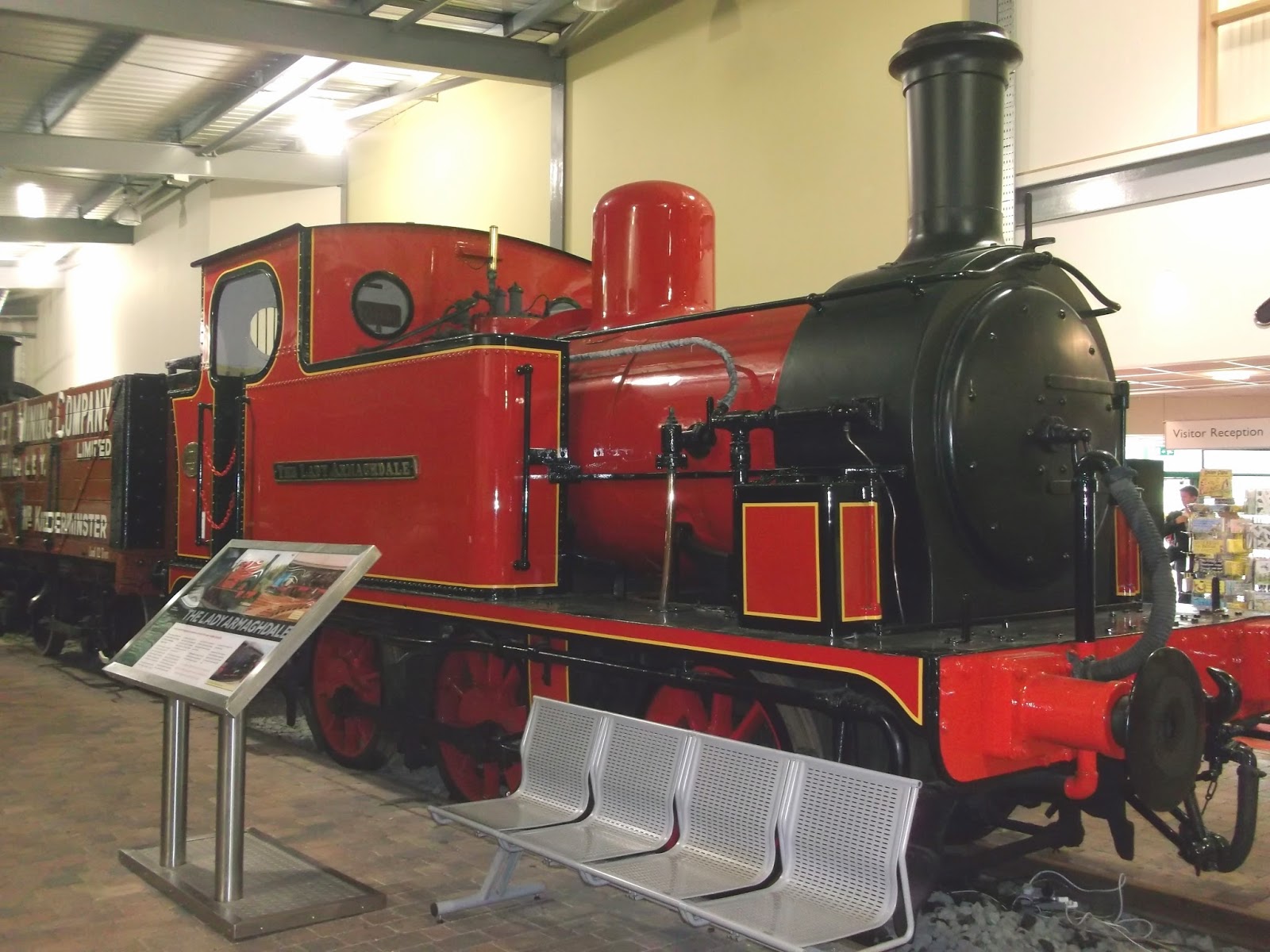
The Lady Armaghdale
Now known as No. 686 'The Lady Armaghdale' this smart little locomotive was delivered new, by the Hunslet Engine Company Ltd, to the Manchester Ship Canal in 1898. On arrival the locomotive was numbered 14 and given the name 'St John'. It was renamed 'The Lady Armaghdale' in 1963 following purchase by I.C.I Ltd. It was then that it also aquired its very fetching red livery. The locomotive arrived for preservation at Bridgnorth in 1969.


Known as a ‘Mickey Mouse’, one of 128 locomotives built under the direction of H. G. Ivatt, the last Chief Engineer of the London, Midland & Scottish Railway. No. 46443 was built at Crewe at a cost of £8.734. This engine worked at a variety of locations around the Midlands and was used for railway work of all kinds. No. 46443 was withdrawn in March 1967, purchased for preservation, and arrived at the SVR in April of the same year.
 
 
See lots more at http://www.svr.co.uk/


Severn Valley Railway Highley station

 
A very well maintained station as are all on the SVR

 
Here the Caprotti class five waits for the road